



























Solutions
The same platform. Very different problems.
A customer service desk counts seconds of waiting. An IT department counts sites to administer. An organisation in Abidjan counts days without a stable link. Here is what Konvoice changes in each of those cases.
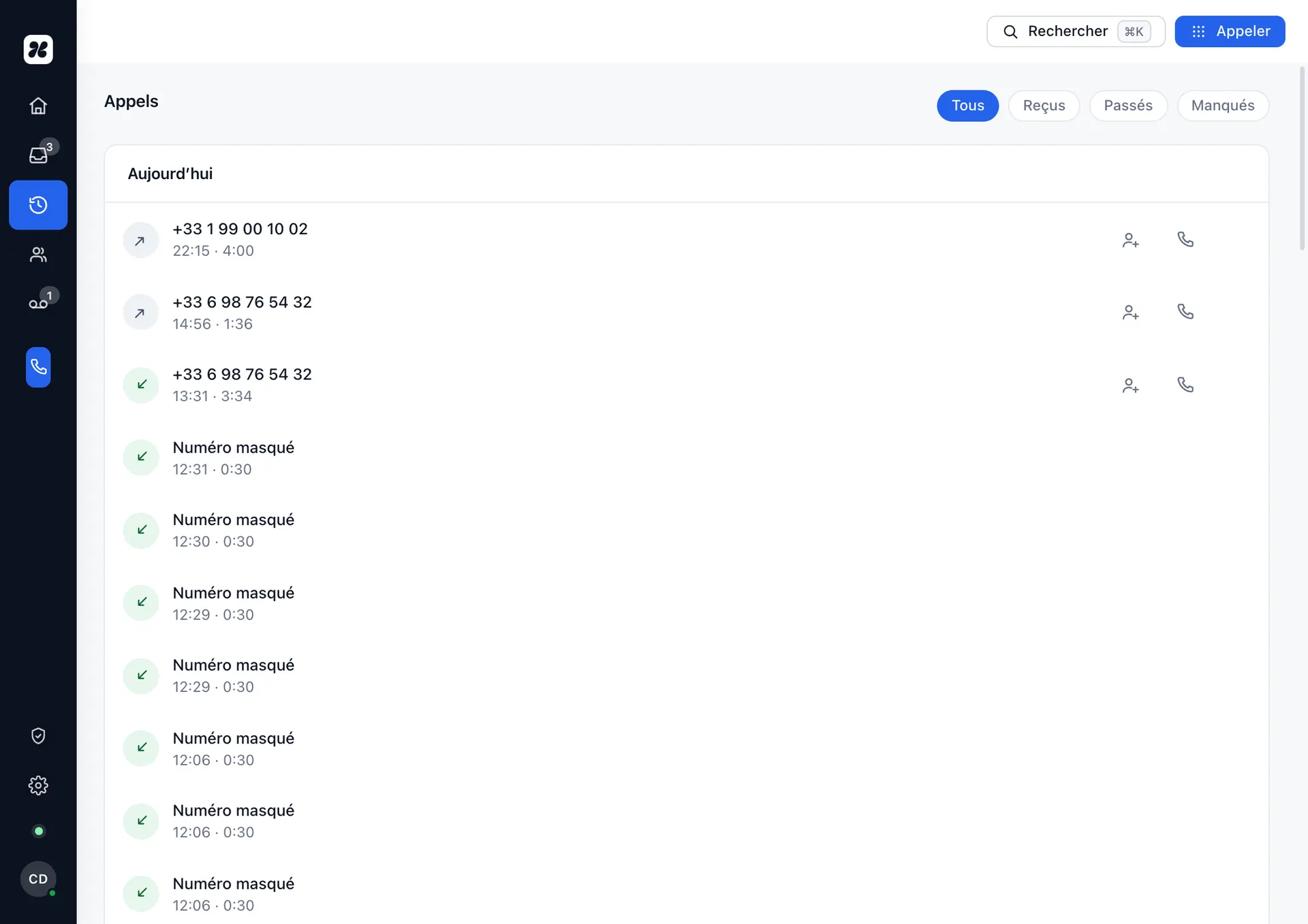
The call log — with names, not just numbers.
Customer service
Waiting time stops being an end-of-month discovery.
Your supervisors see the state of the queue while it is filling up, not in the following Monday’s report.
- Queues with skills and priorities — a call from a customer on a premium contract does not queue behind a request for a brochure.
- Automatic callback — the caller keeps their place without staying on the line. The abandon rate collapses and your agents handle the same load more calmly.
- Monitor, whisper, barge in — to train a new agent without leaving them alone and without embarrassing the customer.
- Reasons counted on every call — Naya labels all the conversations, not the 30 % where the agent had time to tick a box.
- Alert thresholds — past three minutes of average wait, your manager is told while the situation is still recoverable.
Calls waiting
7
Alert threshold: 10
Average wait
1:12
Target: under 2:00
Agents available
9 / 14
3 on break, 2 in wrap-up
Abandon today
2.1 %
Callback offered 41 times
Sales teams
The CRM fills itself in without anybody filling it in.
Time a salesperson spends typing a write-up is time they are not spending on the phone. Konvoice removes the task rather than speeding it up.
- Click to dial from the CRM, the history or any number displayed in the browser.
- Context on screen before you pick up: the case, the last conversation, the offer on the table.
- A write-up by Naya filed into the contact’s activity, with the next deadline created as a task.
- Local caller ID — a call to Abidjan goes out from an Ivorian number, a call to Toronto from a Canadian one. That is what changes the answer rate.
- Hand-off to mobile — the call started at the desk carries on in the car, presenting the same number.
The customer agrees in principle to extend to three further sites. They expect a costed proposal before the 12th and want the warehouse DECT handsets included. Reservation expressed about the porting lead time.
Management and IT
One system to administer, to secure and to defend in committee.
You have often inherited an estate made of three generations of telephony and an integrator contract nobody dares terminate.
- One console for every site — no more VPN to an end-of-life server in a branch cupboard.
- Patches applied without you — Edge appliances included, outside business hours, with automatic rollback.
- Roles aligned on your directory — single sign-on, automatic account creation and removal, two-factor enforceable.
- Readable cost — one subscription per user and itemised usage, presentable as they are to your finance director.
- An exit that works — the right to leave written down, numbers portable at no charge, exports in open formats.
What you remove
The head-office PBX server, the maintenance contract that goes with it, the per-extension licences and the administration VPN.
What you keep
Your numbers, your phones, your dialling plan and, if you want, your carrier.
What you gain
An app for the teams, reports you can act on, and a resilience your current PBX had probably lost.

The same foundation. What changes is what breaks at your end.
Three situations, and the third is the one nobody raises in a sales meeting

By context
Three situations where the choice is decided somewhere other than on features.
Multi-site companies
One dialling plan, ten buildings, rules per site and a single administration — without an outage at head office silencing the branches.
Difficult connectivity
Africa, rural areas, industrial sites, ships. Where the link is not an assumption but a variable, telephony has to hold without it.
Migrating from FreePBX
Taking over an Asterisk or FreePBX installation without stopping the phone system, without reconfiguring the handsets one by one, and without losing the dialling plan.



By industry
Eight trades, and what the phone system interrupts in each.
The industry pages say the same thing differently: they start from the scene — a department, a site, a counter — rather than from the feature.




No customer references published.
Not out of discretion: there is not yet a deployment whose company we can name with their written agreement. The day there is one, it will be named. Until then, the only thing you can verify is the product itself, and a pilot can be asked for with no commitment.
- A pilot before committing — one team in real production, without switching the whole company.
- Training included — one session for the agents, one for the administrators, in French, English, Italian or Spanish.
- A named contact throughout the rollout, reachable by phone.
- Rollback available at every stage of the migration.
See Konvoice on your own numbers.
Thirty minutes, your call plan, your network constraints. We cut the link live and show you what keeps running.
No commitment. No card number asked for.