

















Multi-site
Ten buildings, a three-digit number to reach anybody.
Multi-site telephony always fails in the same place: head office centralises everything, then an outage at head office leaves the branches mute. Konvoice gives each site its autonomy while keeping a single administration.
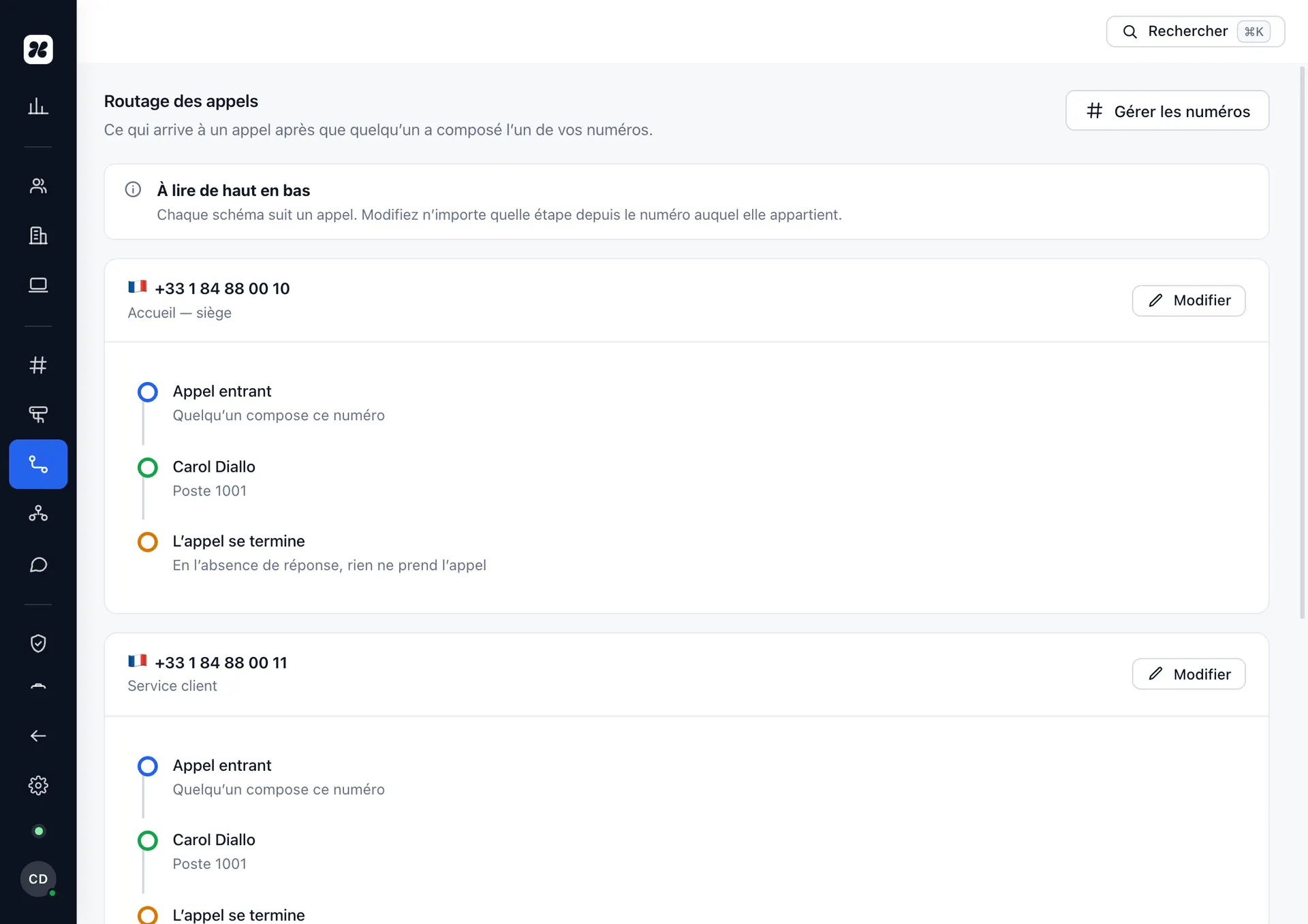
One dialling plan, as many sites as you need.
The model
A company, sites, teams.
Three levels, each answering a precise question your administrators ask themselves.
The company
The dialling plan, the security policy, the roles, the billing and the rules that apply everywhere. Defined once, inherited by every site.
The site
A physical address, its opening hours, its numbers, its backup lines, its Edge appliance and its local administrator. A site keeps working if head office goes down.
The team
The queues, the ring groups, the supervisors. A team can span several sites: the “Support” queue rings in Abidjan and in Casablanca depending on availability.

Three digits to reach anybody, in any building.
It is the only thing your teams will notice, and it is the right one
Numbering
Extension 203 is reached by dialling 203, from any building.
Multi-site companies almost all end up with prefixes nobody remembers. We start from your current plan rather than imposing one on you.
- Unique extensions company-wide — this is the recommended mode: three or four digits, with no site prefix to memorise.
- Or extensions per site with a prefix — if your existing plans overlap and renumbering would cost more than it returns.
- External numbers per site — each building keeps its geographic numbers, and the outbound caller ID follows the caller’s site.
- Free inter-site calls — they take your internal network where one exists, the cloud otherwise, and are never charged by the minute.
Autonomy
What each site can do on its own.
The question to ask any multi-site supplier: what happens if the link between the branch and head office drops on a Tuesday at nine in the morning?
| Situation | Classic centralised telephony | Konvoice |
|---|---|---|
| Branch–head office link cut | Branch mute | Internal calls and local phone system maintained |
| Central site failure | Every branch mute | Each site carries on alone |
| Call between two branches | Goes via head office | Direct route where one exists |
| Administration during the outage | Impossible | Local fallback console on the Edge |
| Opening a new site | Work on the central system | Appliance shipped, plugged in, autonomous |
| Different hours per site | Usually worked around by hand | Per site, with local public holidays |
The hierarchy that matters
Head office decides the rules. It does not decide whether the branch rings.
That is the distinction most platforms do not make: configuration comes down from a central point, but the call itself is handled as close to the handsets as possible. An unreachable head office then becomes an administration problem, not a telephone problem.
- Inherited by default — the dialling plan, the roles and the security policy are defined once.
- Overridable per site — hours, public holidays, numbers and backup lines stay local.
- Local administrator — the branch manager runs their own extensions with no ability to touch other sites.
- Autonomous during an outage — each site keeps what it needs to run on its own.
Opening a site
One more branch is no longer a project.
Opening an extra building used to take weeks and an integrator visit. It now takes a parcel and a network socket.
- You declare the site in the console: address, opening hours, extension range, numbers wanted.
- The Edge appliance arrives prepared for that site, sealed, with its cryptographic identity.
- On site, somebody plugs it into power and the network. No local configuration.
- The phones present on the network are detected and offered for adoption; you approve them from the console.
- The site is in production. You never went there.
Day 0 · declaration
Ten minutes in the console. The numbers are ordered or ported.
Day 1 · dispatch
The appliance ships ready. The phones can go out at the same time, already associated with the site.
Day 2 · plugging in
One person on site, five minutes, no telecoms skills required.
Day 2 · production
You approve the appliance’s fingerprint and the detected handsets. The site is on the phone.
Multi-site questions
Do we need an Edge on every site?
Can we have different administrators per site?
How are calls between sites billed?
Our sites are in different time zones.
Does a site abroad create a regulatory problem?
See Konvoice on your own numbers.
Thirty minutes, your call plan, your network constraints. We cut the link live and show you what keeps running.
No commitment. No card number asked for.